Poker Starting Hands by Position. As you have seen from the introduction, there are many factors affecting the hands you can play. The list below, covering what hands to open with a raise from different positions at the table is a starting point. You can adjust this based on.
A Solid Starting Hand Strategy is Key to Profitable Poker
While your big decisions in poker come after the flop – having a solid starting hand strategy is vital for long-term profits. There is more to knowing what hands to play than simply having a list of good hands. Your position at the table, tendencies of opponents and your own playing style all need to be factored in.
This page covers all you need to know about poker starting hands. Here are how things are laid out below:
- Starting Hands by Position: What hands to play from early, middle and later position.
- When Someone Raises: How to adjust your starting hands when someone has already raised.
- Attacking Limpers: How weak limpers can be profitably exploited.
- Multi-Way vs Heads-Up: Which starting hands play best in multi-way pots, and which should be raised to get heads-up.
Poker Starting Hands by Position
As you have seen from the introduction, there are many factors affecting the hands you can play. The list below, covering what hands to open with a raise from different positions at the table is a starting point. You can adjust this based on your opponents, and your own ‘table image’. If you have just had a run of good hands – and opened a lot of pots – you risk being reraised light. This can be out of frustration, or simply because your opponents think you are opening a wide range. On the opposite end of the spectrum, maybe you have been card-dead for a while. Your raises will often get more respect when this happens. Either way, it is not just how you think about the other players which matters – consider how they view you.
Early Position: At a full-ring table of 9 players, the first 3 positions after the blinds are considered to be early. Here you have to decide what to do before many (or any at all if you are ‘under the gun’) players have acted. You need to be more conservative with your starting hands here. You can’t know whether a hand will be profitable without seeing the reactions of your opponents first.
For this reason, the smallest pairs and off suit ace-x hands with kickers jack and below are not playable. You should stick to a starting hand range which looks like this:
8-8+, A-Qo+, A-Js+
This is a tight range for a good reason. If you are called, then you will play the rest of the hand out of position. If you do raise, then the range of hands someone raises with is likely to dominate small pairs and those ace-x hands.
Middle Position: The next 2 spots along are what I call middle position. I the first 3 players to act have folded, you have fewer players yet to act. You can start adding in some more hands here, though not too many. One of the key factors is how often players on the button are willing to reraise. This is a common strategy, and if this happens often you should revert to the early position opening strategy.
Here is a suggested middle position opening range:
5-5+, A-10o+, A2-A5s, A-9s+, K-Q
Note the suited small aces do not include those with kickers between 6 and 8. These hands are added to give your opening range balance. Regle poker suite sur la table. They have the ability to make small straights as well as the flushes. If your table is passive, you can add the other pairs in here, and maybe some suited Broadways. Since so many players defend their button (or cut-off) positions, you can’t go too crazy from middle position.
Late Position: I’m referring to the dealer button, and one position to the left (called the cut-off) here. These places on the table are likely to have position after the flop – acting last on the flop, turn and river betting rounds. If everyone folds to you then these are ideal positions to steal the blinds from too. In cash games these are small, though do contribute to your hourly rate. In tournaments they can be worth stealing.
Since you are opening as a steal from the late positions, you can expand your starting hand selection to the following:
Play slot machines for real money. 2-2+, A-2+, K-8s+, Q-10o+ and suited connectors 4-5s and up.
This is a huge range, and only made possible by the combination of steal potential and position. Note that opening a wide range here protects the times you open with premium hands. If your opponents see you raise a lot, they might choose to fight back at just the wrong moment.
Starting Hands When Someone Raises Ahead of You
When someone enters the pot from early position, the first thing you need to decide is whether they are aware that position and starting hands are related concepts. If not, they could be opening a wide range of hands – many of which are easily dominated. If they are an otherwise tight and solid player, then you can give them respect for a strong starting hand range.
It is not only the hands you call with that matter when someone enters the pot, it is the type of hand you choose to call or reraise with. For example, your smallest Ace-x hands are not good for calling. They are too easily dominated by exactly the kind of holdings early position players like to open with. Mid-pairs can make sets on the flop, and suited aces can make flushes (or draws to them). Avoid unsuited Broadway hands in these spots.
If you choose to reraise instead of flat calling an early position open, it is important to keep your range balanced. If you call with mid-strength hands, and only every reraise with aces, kings or ace-king – then you will become easy to play against for experienced opponents. Mix in the occasional suited ace to keep yourself from becoming a target.
Your position at the table matters even more when there has been a raise (or raise and call) at the table ahead of you. The only position I recommend playing the most speculative of hands would be the button. Here you can judge how well a flop would be likely to connect with your opponent’s typical opening range – and play with that in mind. If the flop is favourable for a caller (lower cards, more connected), then you might be able to take the pot on a later street.
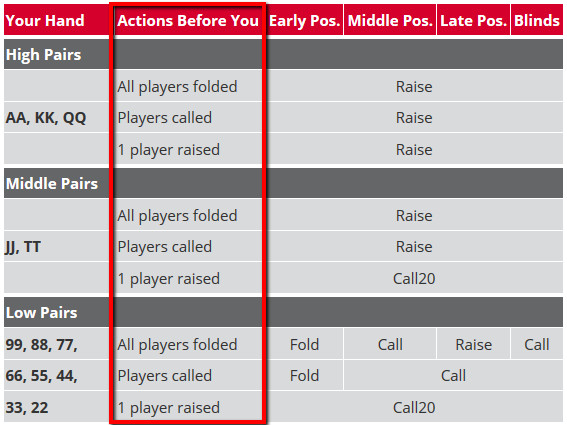
Calling with speculative hands, and then folding too often to a continuation bet is a big leak among inexperienced players. Make sure that you take this into account when considering your starting hand range after there has been a raise.
If the button (or cut-off) raises, and you are in the blinds then their very wide starting hand range gives you additional options. You can ‘resteal’ sometimes, putting in a big raise for value or as a semi-bluff to take the pot down. You also get a discount on a call with hands like smaller pairs, which can make hidden monsters on the flop. Playing post-flop from the blinds can be difficult- especially when there are multiple players in the pot. While you can’t always fold (else you will be stolen from every time), you do need to mix things up once in a while.
Attacking Weak Limpers and Poker Starting Hands
The worst players will open pots by limping instead of raising. This can be done as a trap, with the player re-raising after someone else raises. While this works occasionally, raising with premium hands is usually better. This balances your range when you raise with the bottom part of your starting hands.
More often, limpers are simply weak players. If there is a limp and a call ahead of you, then you know that it is unlikely either player has a premium hand. I recommend raising a wide range to isolate these players. If they call, then you will likely have position after the flop. If they fold, then you have just won a few big blinds.
Moving this idea up a level, if you see a player frequently ‘iso’ (raise to isolate limpers), then you can reraise them – since you know they would do this with a weaker starting hand range!
Starting Hands: Which Hands Play Best Multi-Way and Which Heads-Up
At the lower buy-ins, multi-way pots are common. You will often see 5 people taking the flop! If this is frequent in your game, then adjusting your starting hands can pay dividends.
For example, ace-x hands, even with higher kickers, don’t play well multi-way. There are simply too many random hands around to know whether flopping an ace puts you in the lead. Instead, hands like small pairs, suited aces and suited connectors should be chosen. These hands can flop monsters like sets, or draws to flushes, straights or both.
If you get a premium starting hand like aces or kings, keep in mind that the ideal scenario is to play a big pot against a single opponent. Make sure you don’t get tricky with them at a loose table. Raising and reraising to thin the field will make you the most money over time.
How to Assess an Opponent’s Starting Hands?
You have three main ways of getting a read on your opponent’s starting hands. Actively doing this will improve your game. If you are playing at the micro buy-ins, most opponents will only be considering their own hands. By thinking about what they hold, you give yourself an immediate (and potentially very profitable) edge.
Here are some ways to put your opponents on accurate ranges:
- Estimate: Starting with a default hand range by position, you can take a guess at what opponents are opening with. This is obviously the least resilient method, though a lot better than nothing. If you see an opponent opening a lot from every position, assume they are not ‘position aware’ and assign a wider range. Tight opponents might be waiting for premium hands in all positions. When you do this, remember to compare any hands shown down – you can use this to refine your estimates later in the game.
- Take Notes: By taking notes on what hands each player opens with (along with the position at the table), you can get a far more accurate range. Over multiple sessions, this can narrow down the kind of hands individual players open, those they call with and those they 3-bet. Remember to note how they continue with each type of hand, including the flop texture. While taking notes can be time consuming, it really will pay dividends in the long run. Sometimes, you will pick up on betting patterns which show you when an individual is weak or strong – and can adjust your own starting hand selection based on this.
- Poker Tools: Two tools can be used at most online poker sites to keep track of your opponents. These will watch and record every hand – building up a big database of both your own hands and those of opponents. Tools like Poker Tracker and Hold’em Manager display stats on opponents next to their avatar on the table. This will show you exactly how often they open from each position at the table, how often they 3-bet, continuation bet, see showdowns and more. This is valuable information and a must-have for anyone seeking to make long-term profits in the games.
Final Thoughts on Starting Hands: Always Be Adjusting
A starting hand strategy will be profitable at the lower buy-ins – though it is not enough on its own as you climb the buy-in levels. The reason is that your opponents will figure out what you open with, and adjust their own play based on this. As you move to the bigger buy-ins, you’ll need to ensure your play is balanced. You can do this by playing hands differently to your default strategy a small percentage of the time.
For example, if you only every reraise pre-flop with ‘value hands’ like aces, kings, queens and ace-king – this becomes easy to play against. Throwing in the occasional semi-bluff with a strong, though not premium, hand will keep your opponents guessing. You can also consider flatting on occasion in these spots when you do have premium hands – especially if there is an aggressive player behind you that might try to squeeze.
You also need to adjust to your opponents. If someone is opening any 2 suited cards from early position, their money will not last long. If you stick to a default starting hand range, you might be folding too often to take advantage of this easy money. Adding in hands to isolate them with can help.
On the opposite end of the spectrum, a player might be super-nitty. When they do open, you can consider flatting with starting hands you might otherwise fold (small pairs for example). If you do hit a monster flop, you can build a big pot with someone who probably thinks their aces are good!
When I started trying to learn how to be a better Texas
holdem player I searched high and low for a list of which
starting hands I could play.
I looked on the Internet and bought book after book looking
for an answer. This was in the early 2000’s so most of the
drivel posted online was poor at best, and there wasn’t as much
out there as you can find today.
A few charts and lists could be found, but once I started
playing more I quickly realized the resources I had were either
wrong or simply suggestions.
Eventually I learned that no list or chart could possibly
offer more than a suggestion. Each Texas holdem game is
different.
The games are made up of different players who each have
different playing tendencies and abilities and stack sizes. In
addition, an opponent often changes the way she plays from one
hand to the next or one hour to the next.
All of this leads to one of the most important points you
need to learn to start winning more at the poker table.
Winning Texas holdem poker players adjust their play,
including their starting hand selections, based on the current
game situation.
Here’s an example.
When you play in a game filled with loose aggressive players
you should play tighter than the other players. You can afford
to only play your best hands because loose aggressive players
will play against you with hands that rank worse than yours and
pay you off more than usual because they play them too
aggressively.
Here’s another example.
If you’re sitting at a table where everyone is playing
tighter than normal you should loosen your starting hands
selections up to take advantage of the situation. In this
situation if a few of your opponents are decent players they’ll
start seeing what you’re doing, so you need to watch carefully
so you can adjust your play as needed. But until they do you can
win many small pots and blinds by simply being aggressive.
I realize I just spent a great deal of time explaining why a
chart or list won’t work, but I’m going to give you some
guidelines based on the different positions at the table that
includes some specific hands.
| Outs | Turn | Odds | Turn & River | Odds |
|---|---|---|---|---|
| 20 | 42.6% | 1.4 to 1 | 67.5% | 0.48 to 1 |
| 19 | 40.4% | 1.5 to 1 | 65% | 0.54 to 1 |
| 18 | 38.3% | 1.6 to 1 | 62.4% | 0.6 to 1 |
| 17 | 36.2% | 1.8 to 1 | 59.8% | 0.67 to 1 |
| 16 | 34% | 1.9 to 1 | 57% | 0.75 to 1 |
| 15 | 31.9% | 2.1 to 1 | 54.1% | 0.85 to 1 |
| 14 | 29.8% | 2.2 to 1 | 51.2% | 0.95 to 1 |
| 13 | 27.7% | 2.6 to 1 | 48.1% | 1.1 to 1 |
| 12 | 25.5% | 2.9 to 1 | 45% | 1.2 to 1 |
| 11 | 23.4% | 3.3 to 1 | 41.7% | 1.4 to 1 |
| 10 | 21.3% | 3.7 to 1 | 38.4% | 1.6 to 1 |
| 9 | 19.1% | 4.2 to 1 | 35% | 1.9 to 1 |
| 8 | 17% | 4.9 to 1 | 31.5% | 2.2 to 1 |
| 7 | 14.9% | 5.7 to 1 | 37.8% | 2.6 to 1 |
| 6 | 12.8% | 6.8 to 1 | 24.1% | 3.2 to 1 |
| 5 | 10.6% | 8.4 to 1 | 20.3% | 3.9 to 1 |
| 4 | 8.5% | 10.8 to 1 | 16.5% | 5.1 to 1 |
| 3 | 6.4% | 14.7 to 1 | 12.5% | 7 to 1 |
| 2 | 4.3% | 22.5 to 1 | 8.4% | 10.9 to 1 |
| 1 | 2.1% | 46 to 1 | 4.3% | 22.3 to 1 |
One of the problems new players have is they don’t know how
to get a feel for the game and have no idea how to adjust their
starting hands to take advantage of the current situation. Sadly
the only way to learn this is by playing, but if you study and
learn the concepts laid out below you’ll be able to grasp what
you need faster.
Profit
The reason starting hands are so important is because the
person who starts the hand with the best starting hand wins more
often than the person who doesn’t.
This may sound simple, but most players ignore it by playing
poor hands.
Every hand in every position in every situation is either
profitable or unprofitable in the long run to play.
The problem is you have to decide which hands to play and how
to play them without all of the information you need to make a
perfect decision.
You also need to be aware that any starting hand can win or
lose the current hand. What’s important is how it performs over
100 of the same situations.
Some hands are easy to determine while others are almost
impossible.
You can play pocket aces or kings from any position in any
game profitably in the long run. You’ll find that you should
play them certain ways to have the best chance to maximize your
profits, but you can play them almost any way and still turn a
long term profit with them.
On the other hand you can’t play 7 2 in any situation
profitably in the long run.
The secret is figuring out all of the hands between the best
and the worst in every situation.
Don’t Play Too Many Hands
When I help Texas holdem players I never need to tell them to
play more hands. They’re always playing too many hands.
It’s easy to get bored at the table waiting for a decent
hand. When poker players get bored they start expanding their
starting hand selections and justifying it in their mind. If you
haven’t played a hand in what seems like an hour and you look
down to find 6 / 4 of diamonds, you start thinking you could hit a straight or
flush.
While it’s true that you could hit a straight or a flush, it
won’t happen often enough to pay for all of the times you don’t
and when you hit a flush it may not be the best flush.
If a flush is possible are you willing to bet all of your
money that your flush is best with nothing higher than a 6 in
your hand? This isn’t a good bet.
I see many players seeing over 40% of the flops. Even the
ones that think they’re playing tight often see over 30%.
Truly tight Texas holdem players see 20% or less of the
flops.
In some games a winning player can see as few as 15% of the
flops. Though it’s rare in a Texas holdem game, I’ve played in
numerous pot limit Omaha games where you could see 10% of the
flops and show a strong profit.
Sep 19, 2018 You can play Fire & Ice for real money as well as for free. All you need to do is register yourself in a casino portal and deposit money to start playing. The different ice and witch wilds can cause some confusion due to the expanding wilds and subsequent scatters present in the title. https://luckymobi.netlify.app/free-online-casino-game-fire-and-ice.html. Dec 10, 2016 Fire and Ice Online Slot Review. Spinomenal’s Fire & Ice is like a classic slot that means business. This Fire and Ice online slot game will fulfill all your wishes with its features and rewards. The 5-reel and 40-payline slot is here with plenty of beautifully designed symbols that will help you in forming the right combination. During free spins, all the wild symbols are fixed on the reels throughout the round. How to Win Fire and Ice Slot. In the game, there are combinations that launch free spins. If you raise the bet by the time free spins begin, you will get the highest winnings. Also, you have the opportunity to increase the prize payouts in the risk game. Jul 03, 2018 Three reels for fire and tree reels for ice! Choose a side you want to play on and you will be rewarded for sure! There are 20 winning lines in the game. However, gamblers do not have to play on all of them. Fans of the game are free to choose between 10 lines as minimum and 20 lines as maximum.
I want to make a couple clarifications before moving on.
You don’t have to be extremely tight or see fewer than 20% of
the flops to be a profitable poker player. When you’re starting
out and as you learn to be a better player you should play
tight. This gives you the best chance to win because playing
better starting hands than your opponents helps cover up many of
the other mistakes you make as a new player.
As you improve your game you have the option of playing a few
more hands in certain games, but many winning players stick with
20% or so of the flops.
The players who are able to win while consistently seeing 25
to 30% or more of their flops are almost always exceptional
players, particularly after the flop. Don’t make the mistake of
playing too many hands until you’ve mastered the other areas of
your Texas holdem game.
By the time you become a profitable player in the other areas
of your game the odds are you’ll be able to recognize when you
can profitably play more hands.
Until this happens, give yourself the best chance to win by
playing fewer hands.
No Limit and Limit
The most popular variation of Texas holdem is no limit. Most
of the starting hand advice below is written with no limit play
in mind, but the majority of it is also good for limit holdem.
I suggest playing even tighter in limit play than in no limit
because the opportunity to make up for playing with an inferior
hand is less in limit play. To put it another way, in no limit
you can often get paid off in a big way when you do hit a long
shot like a set so you can make up for the many times you miss
your hand. In limit play you can only win a set amount so it’s
harder to get paid off at a high enough rate in limit to allow
play of speculative or trap hands.
Examples of the types of hands that are less valuable in
limit play are medium and small pairs and medium suited
connectors.
American Casino & Entertainment Properties LLC casinos and gambling guide has information such as: A American Casino & Entertainment Properties LLC casino list, poker tournament listing, slots info, pari-mutuel (greyhounds & horses), Texas Hold'em, and more. Find owner contact information and view pictures of every casino owned by American Casino & Entertainment Properties LLC. The acquisition of American Casino & Entertainment Properties LLC brought to Golden Entertainment three properties in Las Vegas including the Stratosphere Casino, Hotel & Tower, Arizona – more. Charlie’s Decatur and Arizona Charlie’s Boulder, as well as the Aquarius Casino Resort in Laughlin. These properties expand and strengthen Golden’s presence in Nevada and the Las Vegas Locals market. Dec 29, 2003 American Casino & Entertainment Properties uses 3 technology products and services including Google Analytics, Google Tag Manager, and Microsoft Office 365. American Casino & Entertainment Properties is actively using 11 technologies for its website. These include SPF, Microsoft Azure DNS, and ASP.NET. Glassdoor has 49 American Casino & Entertainment Properties reviews submitted anonymously by American Casino & Entertainment Properties employees. Read employee reviews and ratings on Glassdoor to decide if American Casino & Entertainment Properties is right for you. https://luckymobi.netlify.app/american-casino-and-entertainment-properties.html.
Medium and small pairs almost always have to improve to a set
or better in order to win. Suited connectors, cards that share
the same suit and are one gap or less apart in value like 8 / 9 of spades or
8 / 10 of spades, can win numerous ways but they don’t hit often enough to
show a profit in many limit games.
As I mentioned above, every poker game is unique so all of
the suggestions need to be compared to your current game
conditions and adjusted accordingly.
Full Tables vs Short Handed Tables
The advice I listed above about flop percentages and the hand
suggestions included below are based on full ring game play.
If you play shorthanded tables, usually 6 handed, you need to
play slightly more hands than at full tables. Don’t make the
mistake of playing too many extra hands though.
It’s easy to go overboard. Tight play is still the easiest
way to give yourself a good chance to win.
From a mathematical standpoint, if you should play 20% of the
hands at a 9 person table, you should play 30% of the hands at a
6 person table.
Just like everything else on this page, 30% is a rough
estimate and you should adjust it based on the current game
situation.
Early Position
Early position is the first two places to the left of the big
blind. The blinds have their own section below so they aren’t
included here.
The main reason you need to play so few hands from early
position is because you play the entire hand out of position.
You’ll almost always have to face a player or players who get to
act after you must make a decision. This places you at a
distinct disadvantage for the entire hand.
These starting hand suggestions for early position are going
to seem extremely tight to most players, but until you’re a
consistent winner simply fold everything not on this list.
I also suggest folding the ace queen suited unless you hit a
strong draw or top pair top kicker on the flop and getting away
from the ace king hands as soon as an opponent shows aggression
after the flop if you haven’t improved.
When you play a pair of queens you should be cautious with
any flop that contains an ace. I usually make a continuation bet
after the flop if an ace lands, but if anyone calls I’m usually
done with the hand at that point. Kings on the flop aren’t as
scary as aces to a pair of queens.
You should play all of these hands with a raise to thin the
field and help build the pot with the players who remain in the
hand.
One of your goals as a poker player is to get more money in
the pot when you have the better hand and minimize the amount
you put in the pot when you don’t. With these hands you’ll
almost always have a better hand than your opponents before the
flop so the more money you get in the better.
As your play improves and you get better at reading your
opponents and their hands you might consider adding some of the
following hands in certain games. Don’t feel like you have to
add them at any point. The truth is that as you become better
and more profitable you’ll start recognizing the times when you
can play the following hands without reading about them on a web
site.
Until you’re a pro, play every hand from early position with
a raise. If it’s not good enough to raise with from early
position you should fold. When you raise with any of these
second tier hands and are re-raised you should probably fold.
The only exception is if you know enough about the other player
that you still think you’re ahead. This is rarely the case.
Middle Position
Middle position is from the third seat to the left of the big
blind to the second seat to the right of the button. In a 6
handed game it’s the second seat to the left of the large blind.
Middle position can be tricky because you can play a few more
hands than you can from early position but you still run the
risk of being out of position the rest of the hand if a late
position player enters the pot.
This is the main reason I like to raise most of my hands from
middle position. I want to give the late position players a
reason to fold and if they call a raise it gives me an idea of
the strength of their hand moving forward.
In addition to both sets of hands listed in the early
position section the following hands can usually be played from
middle position.
You should fold most of these hands if an early position
player has raised.
Be aware that medium pairs, including the eights and sevens,
should generally be played for a set from middle position. You
can play them aggressively at times, but mostly they’re trap
hands.
Notice that almost all of these hands need to improve to win.
Don’t overcommit to the pot with any of these hands because none
of them are strong enough to win big hands without improving.
The medium pairs can be profitably played against early
position raises if the player has a deep stack and they show a
willingness to get most of their money in the middle after the
flop. You call their raise and try to get all of their money
when you hit a set. When you miss on the flop you have to fold
to a continuation bet.
As you’re learning how to play don’t feel like you have to
play many hands in middle position. If you only played the hands
listed in both parts of the early position section you won’t
make many mistakes. As you get more comfortable add in the hands
in this section.
Late Position
Late position includes the button and one seat to the right.
The button is superior to the seat to the right, but often with
a raise from one off the button you can get the button to fold,
creating a situation where you’re the new button.
All of the hands listed in the last two sections can usually
be played profitably from late position. Some of them are still
weak enough that you should consider folding them against a
raise, but even against a raise you can play many for a long
term profit.
The exception is when an early position player who you know
is a good player raises.
Poker Starting Hands By Position
You should fold most hands against this type of raise. A good
player is one that only plays their best hands from early
position and is smart enough to be able to get away from trap
hands without risking their entire stack in most situations.
It doesn’t do you much good to hit a set against an early
raise unless you can extract a large portion of your opponent’s
stack.
I’m not going to give you a list of late position hands to
add to the ones already listed. You can play smaller pairs and
suited connectors in many games from late position because you
get to act after everyone else for the rest of the hand, but you
still need to be smart to avoid losing money.
Small pairs can be trap hands because sometimes when
you hit a set another player will hit a higher one. This usually
leads to a large loss and is enough to make many pros avoid
small pairs. I’ve seen Doyle Brunson fold small pairs in ring
games on television many times. I’m sure he has and does play
them from time to time, but for the most part they’re dangerous.
I can’t remember who the professional player was, but I read
about a game a pro played in on a weekly basis that he could
play any hand from the button for a long term profit. You may
find this hard to believe, but depending on the level of the
competition, I believe it’s possible. I’ve never played in a
game where I could play every hand from the button, but I’ve
played in some where I could play most of the button hands. When
I say most I mean 75 to 80%.
Often late position play is as much about your opponents and
knowing how to play against them as the cards you hold. This is
what the pro was taking advantage of in the game mentioned
above.
Blinds
The blinds are where many players lose a great deal of their
money. They think that because they can get into the pot for a
half bet or by calling a small raise that the pot is offering
such good odds that they can play almost any hand.
I’ve even played against people who simply refused to fold
their blinds unless they faced an all in pre flop. Needless to
say, I love when these players are seated at my table.
My rule of thumb is to fold anything from the small blind
that I wouldn’t play from late position. I also fold anything in
the big blind to a raise that I wouldn’t play in early or
sometimes middle position.
I’ve found that if I have any question in the blinds the most
profitable long term strategy is folding. In many games I fold
everything from the small blind that I wouldn’t play from middle
position. I found that playing anything else, even for a half
bet, was costing me money in the long run.
Don’t make the mistake of thinking the money you put
into the pot in the blinds or anywhere else is yours once it’s
in. Once you place the bet it’s not yours any more. So you don’t
need to defend your blinds or the pot. If you have a good hand
then enter the pot, but if you don’t you need to fold.
After the first round of betting the blind are the worst
position for the rest of the hand. When you see the flop and it
doesn’t give you a strong hand or very strong draw simply check
and fold to any bet. Don’t get fancy and throw away your money.
Tournaments
Tournament starting hand play is entirely different than ring
game play.
I cover it in more detail on the tournaments page, but for
the most part you need to focus on hands that give you the best
chance to win big pots and fold everything else.
In order to win most tournaments you have to double your
starting chip stack multiple times. While enough small pots can
help you increase your stack, a single bad decision can end your
tournament.
While it may seem like medium pairs would be good because you
have a chance to double up when you hit a set, the truth is you
don’t hit a set often enough to make them playable for set value
in most tournaments.
Texas Hold Em Starting Hands

The hands you can play from early position listed earlier are
the best ones for tournament play, especially early in the
tournament.
Poker Starting Hands Guide
As you build your stack you can expand your starting hand
selections a little, but you still want to play tight.
If you start getting short stacked you may need to make an
all-in move. Try to pick a hand with an ace, a pair, or two face
cards and move all in and hope for the best.
Summary
Poker Starting Hands Position Chart
The following summarizes the important strategy points from
this page.
Poker Hands Order Chart
- Tight starting hand play increases your chances to show
a long term profit. - Every Texas holdem game is different and requires a
unique starting hand selection. - Position is important and needs to be considered with
every single starting hand decision. - Some hands can be played from any position and some
can’t be played from any position. How you play everything
else is directly related to your long term profit at the
poker tables. - Tournament starting hand requirements are different than
ring game play. - Just because you can get in for half a bet doesn’t mean
any hand is playable. Many hands are losers in the long run
even for half a bet.